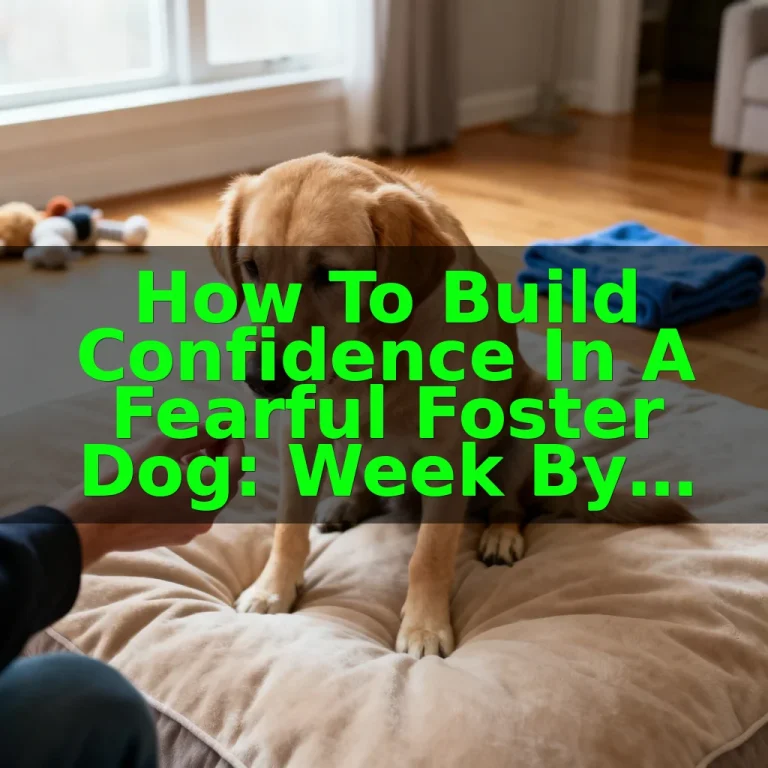
How to Build Confidence in a Fearful Foster Dog: Week by Week
Building confidence in a fearful foster dog takes consistent routines, gradual exposure to new experiences, and positive reinforcement — and real progress typically unfolds over four to six weeks. Understanding how to build confidence in a fearful foster dog week by week gives you a realistic roadmap instead of a guessing game.
Many foster dogs arrive from shelters or the streets with stress responses that look like shutting down, hiding, or even snapping. That behavior is not a character flaw — it is a survival strategy. The good news is that it can change.
What Is the Fastest Way to Build Confidence in a Fearful Foster Dog?
The fastest way to build confidence in a fearful foster dog is through low-stress exposure paired with high-value rewards — a technique called counter-conditioning. Pair whatever frightens the dog with something it loves, at an intensity the dog can tolerate without panicking. Repeat daily in short sessions.
- Start in a quiet, confined space before adding new rooms or people.
- Use high-value treats like small pieces of chicken or cheese for training sessions.
- Keep sessions to 5–10 minutes so the dog never hits emotional overwhelm.
- Let the dog approach people and objects at its own pace — never force it.
- Track progress weekly so small wins stay visible.
- Contact a certified professional trainer if fear escalates to aggression.
Understanding Why Your Foster Dog Is Fearful
Fear in dogs is not random. It usually traces back to one of three sources: lack of early socialization, past trauma, or genetic predisposition toward anxiety. Knowing the likely cause helps you set realistic expectations for the week-by-week timeline.
Undersocialized dogs missed critical exposure windows as puppies. Trauma-based fear often shows up as specific triggers — a raised hand, a broom, a particular type of person. Genetically anxious dogs may need longer timelines and veterinary support alongside training.
Reading Fear Body Language
Before you can help a fearful dog, you need to recognize what fear looks like in real time. The American Kennel Club identifies these common fear signals in dogs:
- Tail tucked below the body line
- Ears pinned flat against the head
- Crouching, cowering, or freezing in place
- Yawning, lip licking, or nose licking out of context
- Whale eye — showing the whites of the eyes
- Turning away or moving behind your legs
When you see any of these, the dog is telling you it has hit its threshold. Back up, reduce the intensity of whatever is happening, and let the dog decompress before continuing.
BEFORE YOU SCROLL PAST
Quick Reads You’ll Love: 👇
👉 Can You Power Tool Specific Items Essebtials
The Threshold Concept
Threshold is the invisible line between a dog that is alert but coping and a dog that is over-reactive or shut down. Training only works below threshold. Once a fearful dog crosses that line, it cannot learn — it is only surviving.
Your goal each session is to stay just below threshold and gradually move that line further out over weeks.
Week-by-Week Confidence Plan
Progress with fearful foster dogs rarely follows a straight line. Some dogs decompress quickly; others need the full six weeks or longer. Use this framework as a guide, not a deadline.
| Week | Primary Goal | Key Activities | Signs of Progress |
|---|---|---|---|
| Week 1 | Safety and decompression | Quiet safe space, minimal handling, consistent schedule | Dog eats consistently, sleeps without panting |
| Week 2 | Routine and first trust-building | Short leash walks, name recognition training | Dog makes eye contact, wags tail at mealtimes |
| Week 3 | Positive associations | Treat-based handling, introduction to one new person | Approaches you voluntarily, accepts gentle petting |
| Week 4 | Gradual exposure | New rooms, low-traffic outdoor areas, basic cues | Recovers faster after a startle, engages in play |
| Week 5–6 | Broader socialization | Quiet public spaces, calm dog introductions if appropriate | Solicits attention, shows curiosity over fear |
Week 1: Decompression Comes First
The single most important thing you can do in week one is almost nothing. Set up a covered dog crate or a quiet corner with a soft bed as the dog’s anchor space. Limit visitors, keep the household calm, and let the dog observe from a distance.
Feed meals at the same time every day. Even if the dog won’t eat in front of you, place the bowl down quietly and walk away. Consistent feeding schedules are one of the fastest ways to establish trust because they make you predictable.
Week 2: Build a Routine the Dog Can Count On
Predictable schedules reduce anxiety faster than almost any other intervention. A 2020 review published in Applied Animal Behaviour Science confirmed that environmental predictability significantly lowers cortisol-related stress behaviors in shelter dogs — findings that transfer directly to foster home settings.
Short leash walks on the same route help the dog map its new territory. Use a no-pull harness so there is no pressure on the neck if the dog startles and pulls. Keep walks short — 10 to 15 minutes — and end before the dog shows stress signals.
Training Techniques That Actually Work for Fearful Dogs
Positive reinforcement is the only training approach with a strong evidence base for fearful dogs. Aversive methods — choke chains, shock collars, or alpha rolls — increase anxiety and can trigger defensive aggression, according to guidance from the American Veterinary Society of Animal Behavior (AVSAB).
“Dogs learn from positive association. The best way to help a shy or fearful dog gain confidence is to expose them to what frightens them at a low intensity and pair this exposure with something positive, like a tasty treat.” — General principle from certified applied animal behaviorists
The Look-at-That Game
Developed by trainer Leslie McDevitt in her Control Unleashed program, the Look-at-That (LAT) game teaches fearful dogs to notice a trigger and look back at you for a reward. It interrupts the fear-trigger loop and replaces it with a coping behavior.
- Stand far enough from the trigger that your dog is aware but not panicking.
- Wait for the dog to glance at the trigger.
- The moment it does, mark with a calm “yes” and deliver a treat.
- Repeat until the dog starts looking at the trigger and immediately snapping back to you.
- Gradually decrease the distance to the trigger over multiple sessions.
Name Recognition and Focus Work
A fearful dog that responds to its name has a communication lifeline. Practice name recognition with soft, high-value training treats in a low-distraction environment before adding any complexity.
Say the name once, wait, and reward any head turn toward you. Never repeat the name more than once in a row — that teaches the dog to ignore repetitions. Ten reps per session is plenty.
Creating a Safe Environment at Home
The physical environment shapes a fearful dog’s recovery as much as training does. A dog that never feels safe at home cannot make progress anywhere else.
Safe Space Setup
Every fearful foster dog needs one spot that is always available and never approached by strangers or other pets without invitation. A calming dog bed placed inside or beside the crate gives the dog a choice of retreat options.
- Cover three sides of the crate with a blanket to reduce visual stimulation.
- Place the safe space away from high-traffic areas like the front door.
- Never use the crate as punishment — it must stay a positive, voluntary space.
- Add an unwashed t-shirt you’ve worn so the dog acclimates to your scent.
Managing Other Pets and Visitors
Introductions to resident dogs or cats should happen through a baby gate or separate room first — not nose-to-nose on day one. Let the fearful dog investigate scent before seeing the animal directly.
Ask visitors to ignore the dog completely on arrival. No eye contact, no reaching out a hand — just sit down and let the dog investigate at its own pace. This approach, recommended by the ASPCA’s animal behavior team, consistently produces faster voluntary approach than any forced greeting.
Sudden sounds are another common trigger. If a dog reacts to the TV or outdoor noise, a white noise machine near the safe space can buffer unpredictable sound spikes.
Common Mistakes That Slow Progress
Even well-meaning foster caregivers can accidentally set a dog back. Recognizing these patterns early saves weeks of frustration.
- Flooding the dog with new experiences too fast. Introducing multiple new people, pets, and environments in the first week spikes anxiety instead of reducing it. Introduce one new thing at a time.
- Comforting excessive fear with prolonged coddling. Holding a panicking dog for long periods can reinforce the fear state. Brief calm reassurance, then redirect to something positive.
- Repeating cues the dog is not ready for. Asking an overwhelmed dog to “sit” repeatedly while it is trembling teaches nothing. Wait until the dog is calm enough to think.
- Skipping veterinary evaluation. Fear that does not improve with consistent training may have a medical component. Thyroid dysfunction and chronic pain are two conditions that can mimic or worsen anxiety.
- Expecting a linear timeline. Two steps forward, one step back is normal. A bad day does not erase two good weeks.
Frequently Asked Questions About How to Build Confidence in a Fearful Foster Dog: Week by Week
How long does it take for a fearful foster dog to feel safe?
Most fearful foster dogs show meaningful improvement within four to six weeks of consistent routine and positive reinforcement. Some dogs with severe trauma histories may take three to six months before they reliably show relaxed body language.
Should I force my foster dog to interact with people?
Forcing a fearful foster dog to interact with people increases fear and erodes trust. Always let the dog choose to approach on its own timeline, and reward every voluntary interaction with a calm, high-value treat.
Can a fearful foster dog ever become fully confident?
Many fearful foster dogs achieve a fully confident, happy life with the right adopter and continued positive training. Others manage well with a calm, structured home and may always prefer predictable environments over busy or loud ones.
What treats work best for fearful dog training?
Small, soft, high-value treats like plain cooked chicken, string cheese, or commercial soft training treats work best for fearful dogs. The treat needs to be worth the risk the dog is taking by approaching or engaging.
Is it normal for a fearful dog to stop eating in the first week?
Reduced appetite in the first three to five days is normal for fearful foster dogs adjusting to a new environment. If a dog refuses food for more than 48 hours or shows other symptoms, contact a veterinarian promptly.
When should I involve a professional trainer or behaviorist?
Involve a certified professional trainer if fear-based behaviors include growling, snapping, or biting, or if the dog shows no improvement after four weeks of consistent routine. Look for credentials from the Certification Council for Professional Dog Trainers (CCPDT).
The One Thing That Changes Everything
If there is a single principle that ties every week of this plan together, it is this: let the dog set the pace, and celebrate every small step forward.
Confidence builds from repeated experiences of safety — not from pushing through fear. Start with a quiet space, a predictable schedule, and five minutes of treat-based training each day. That is enough to begin.
Your foster dog does not need a perfect trainer. It needs a calm, consistent person who shows up the same way every day. That is something you can do starting today.